Personal safety support
Ma’alob
A personal safety check-in product, in production on the web, iOS, and Android. Available on the App Store and Google Play, with routine check-ins, trusted contacts, and discreet alerts in one calm experience.

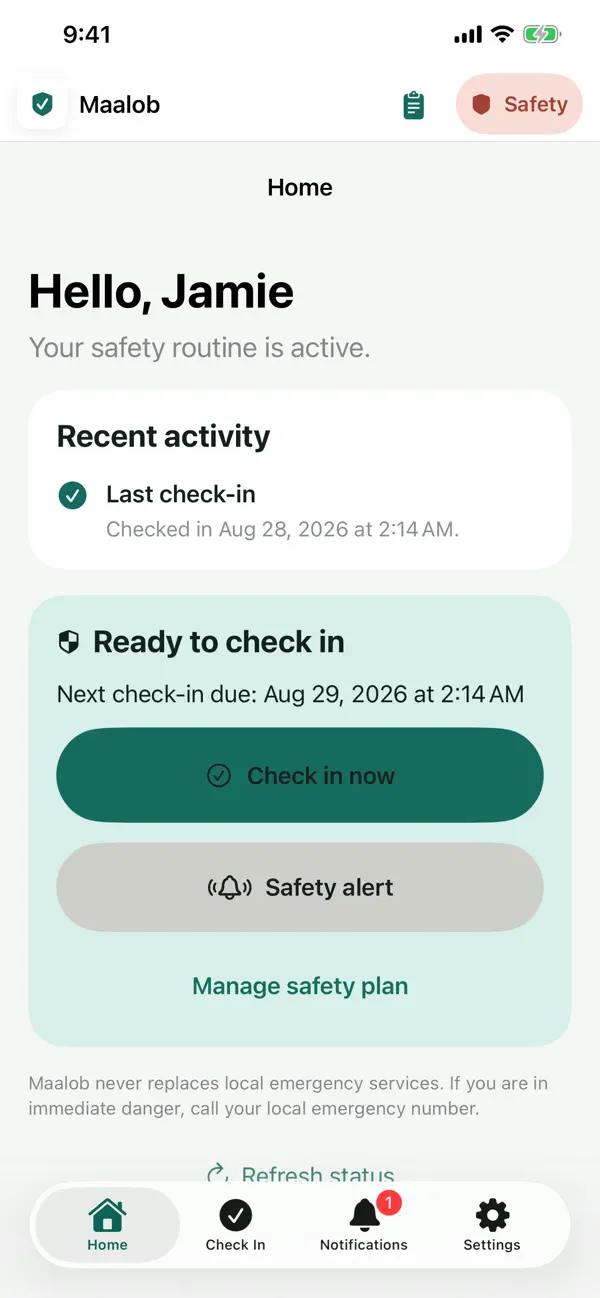
Overview
Context
Ma’alob supports people who want a lightweight way to confirm that they are okay. A person defines a routine and grace period, chooses trusted contacts, and checks in from any device. Missed check-ins or a discreet reverse-PIN signal can initiate notifications.
The challenge
A safety-adjacent product must be calm under stress, precise about time, and honest about its limits. The flow must make routine actions effortless while treating alerts and sensitive information with restraint.
My role and responsibility
I shaped the product behavior and built the web experience, backend workflows, scheduling model, trusted-contact flow, and cloud operation within the Opinr ecosystem.
- Technology
- iOS · Android · Django · Scheduling · Messaging · Privacy · Responsive web
- Status
- Live
- Period
- 2024 — Present
Architecture
Public-level conceptual architecture
A deliberately public view: enough to explain the boundaries without exposing sensitive implementation detail.
Select a component to understand its role.
Person
Defines the routine, grace period, trusted contacts, and check-in method.
Key decisions
Make time semantics explicit
Routine, grace period, missed state, and notification state are separate concepts, reducing ambiguity in a time-sensitive flow.
Keep the discreet path discreet
The reverse-PIN interaction is designed to resemble a normal check-in while allowing a different notification path.
State limitations clearly
The product language avoids promising guaranteed safety or guaranteed delivery and keeps emergency-service guidance visible.
Validation and outcome
Evidence before adjectives.
Ma’alob is in production on the web, iOS, and Android. The iPhone app is available on the App Store, and the Android app is now available on Google Play. Both public store listings provide downloadable apps alongside the responsive web experience. The screenshots shown here depict the web product and the released iPhone app.
Lessons
- 01
In sensitive workflows, calm copy and reversible decisions matter as much as the backend.
- 02
Scheduled systems need explicit states, observability, and careful retry boundaries.
- 03
Trust grows when a product states what it can—and cannot—do.